
An Open Letter To Musicians Worldwide - Resist the AI Quantity Culture & Build a Quality Culture
Dec 06, 2025
An Open Letter To Indie Musicians Worldwide (Lessons from Quincy Jones and Chick Corea)
Here’s my direct challenge to every indie artist and band reading this:
If you’re tempted to run your masters through ANY AI stem tool (AudioShake included), I strongly suggest you carry out ruthless Quality Control.
Listen on studio monitors. Test with headphones. Solo every stem. A/B against the original mix.
If even ONE stem has audible garbage (statistically, 1 in 5 will), delete them all.
Then pitch the track proudly WITHOUT stems and include the following message, (feel free to copy/paste it):
“This track was recorded in [year] and no original stems exist nor can they be created from the original sessions. After extensive testing with current AI separation tools, the results were deemed unprofessional and not representative of the recording’s quality. We are therefore submitting the master track AS-IS, with full confidence it will stand strong on its own merits for sync placement.”
That single paragraph screams integrity—and in a market being infiltrated by low-grade “deliverables,” integrity is the new superpower.
Pitch quality stems, or no stems.
Never ship trash.
Stay elite.
(And... to keep up with international trends and to address what millions of Indie Musicians are presently doing: If you use an AI tool, such as SUNO to create a “new cover version” of your old demos in order to increase their production value, A) know exactly what needs to be done with that mix in order to be eligible to receive a Sound Recording copyright from the U.S. Copyright Office, and B) I suggest using the same rule as above when exporting stems from SUNO or any AI platform: Specifically, pitch quality stems or no stems.)
A Vital Message.
This isn’t just about stems. It’s about who YOU are as an artist.
When you lean too hard on AI for every separation, every mix “fix,” every idea, you quietly bypass the very thing that gives a human being real confidence: competence.
Shortcuts feel like rocket fuel today, but oftentimes they rob you of the deep mastery that turns good musicians into legends.
Here’s a challenge I give every private client (and now I’m giving it to you):
The next time an AI tool spits out a result that absolutely blows you away, STOP for a moment.
Don’t run it 25 more times to create 25 more tracks and call it a productive day.
Take that ONE magical result, open it in your DAW, and reverse-engineer every single detail (you can use my revolutionary Checkerboard A/B Mixing System to be able to accurately perceive those details).
Ask yourself questions like these:
Why does this chord progression hit me so hard emotionally?
What IS this chord progression exactly?
What specific voice-leading did the AI use on those background vocals?
How did the kick drum turn out so punchy and warm and rich in this mix? (Use the Checkerboard A/B System to re-record various elements of the mix yourself, so that you can create the same thing - or better - without AI).
Dissect it like an autopsy until you can recreate it with your own hands. (And by the way, this exact philosophy and approach is how Quincy Jones’s mentor, Madame Nadia Boulanger taught Quincy composition and arranging!)
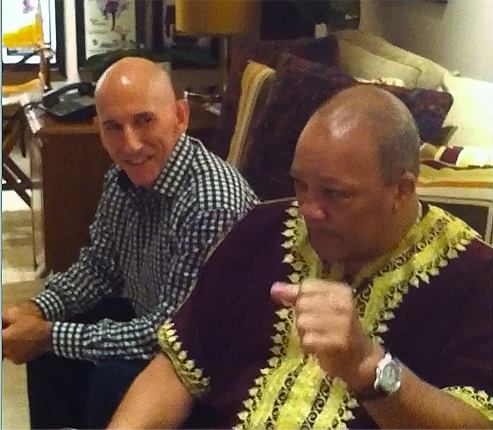
Gary Gray and Quincy Jones
That single exercise will teach you more than a year of mindless prompt-churning.
Because here’s the deeper truth, taught to me personally by two of my greatest mentors:
25-Time Grammy Award-Winner Chick Corea, learning from his mentor L. Ron Hubbard, broke life down into three irreducible aspects that determine the quality of your existence and your value to the world:
1. Your identity as an artist (your unique choice of who
2. to BE, what role you decide to take on).
3. The action or activity engaged in (what you DO).
4. The resulting possession, whether objects, energy, space, or abilities (what you HAVE), which can be a song, a recording, and your confidence through competence.
Mastery of your craft happens with #2: The Action (What you DO).
When you outsource too much of The Action to machines, you can give up your own identity, slow down or stop educating yourself on the application of your craft (what you can DO), and limit or degrade the most valuable possession as an artist (what you could HAVE): true confidence through competence.
You could “have” a high quantity of great songs and recordings, but you may be REDUCING who you really are and what you can learn and do as an artist.
My suggestion?
Draw the line this way: if the results you are getting are gotten in ANY way that results in the reduction of who you are as an artist, and if they reduce your ongoing education and practice of perfecting your craft, back off on the technology right there.
Quincy Jones hammered this home almost every time we spoke. He would look me dead in the eye and say:
“You never work for the machine, the machine works for you.”
He emphasized that technology is merely a tool, and musicians need a deep understanding of music fundamentals to use that tool effectively.
Humanity over technology.
Jones believed that true artistry comes from human experience, emotion, talent, and hard work — traits that no artificial intelligence can ever possess.
Foundation of knowledge.
He stressed the importance of learning music theory and the craft of making music.
His warning was, “If you don’t understand music, you work for the machine.”
Tools, not creators.
He viewed computers and synthesizers as tools to be utilized. He pointed to Stevie Wonder as an example of an artist who masterfully made technology work for him, emphasizing:
“The technology is a tool. You have to know what you’re building to utilize the tool properly.”
Avoiding shortcuts.
Jones often lamented the lack of mastery in modern music production, where technology can fill in the gaps for those without proper training, calling some producers “lazy and greedy.”
Creative control.
He believed artists must have a clear vision of their desired outcome and use technology to achieve it, rather than letting the software dictate the creative process.
So when you’re tempted to let AI do all the heavy lifting, remember Chick’s three steps and Quincy’s warning.
Make the machine serve the musician, never the other way around.
Know your rights and the legal landscape.
There are specific laws governing what you, as a musician, need to know and do when submitting an AI assisted track for copyright protection. I am always here to listen and to help. You can write to me at [email protected] to set up a free 1-on-1 Zoom call with me personally so that I can answer any questions you may have.
Stay sovereign over your craft.
Definition of Sovereign: You’re the boss of yourself. You’re in charge, you make the final decisions, and nobody else rules over you. That’s what “sovereign over your craft” means. No machine, no trend, no label gets to be your boss. YOU decide.
Gary Gray
The Sculptor of Sound
Voting Member of the Grammy® Recording Academy
#1 Charting Billboard Producer & Engineer
Subscribe to Gary's Insider Newsletter!
Get ahead of the curve with this weekly newsletter from Gary Gray and get a copy of Gary's book, THE HOME STUDIO BIBLE, for free as our Thank You Gift!
We hate SPAM. We will never sell your information, for any reason.